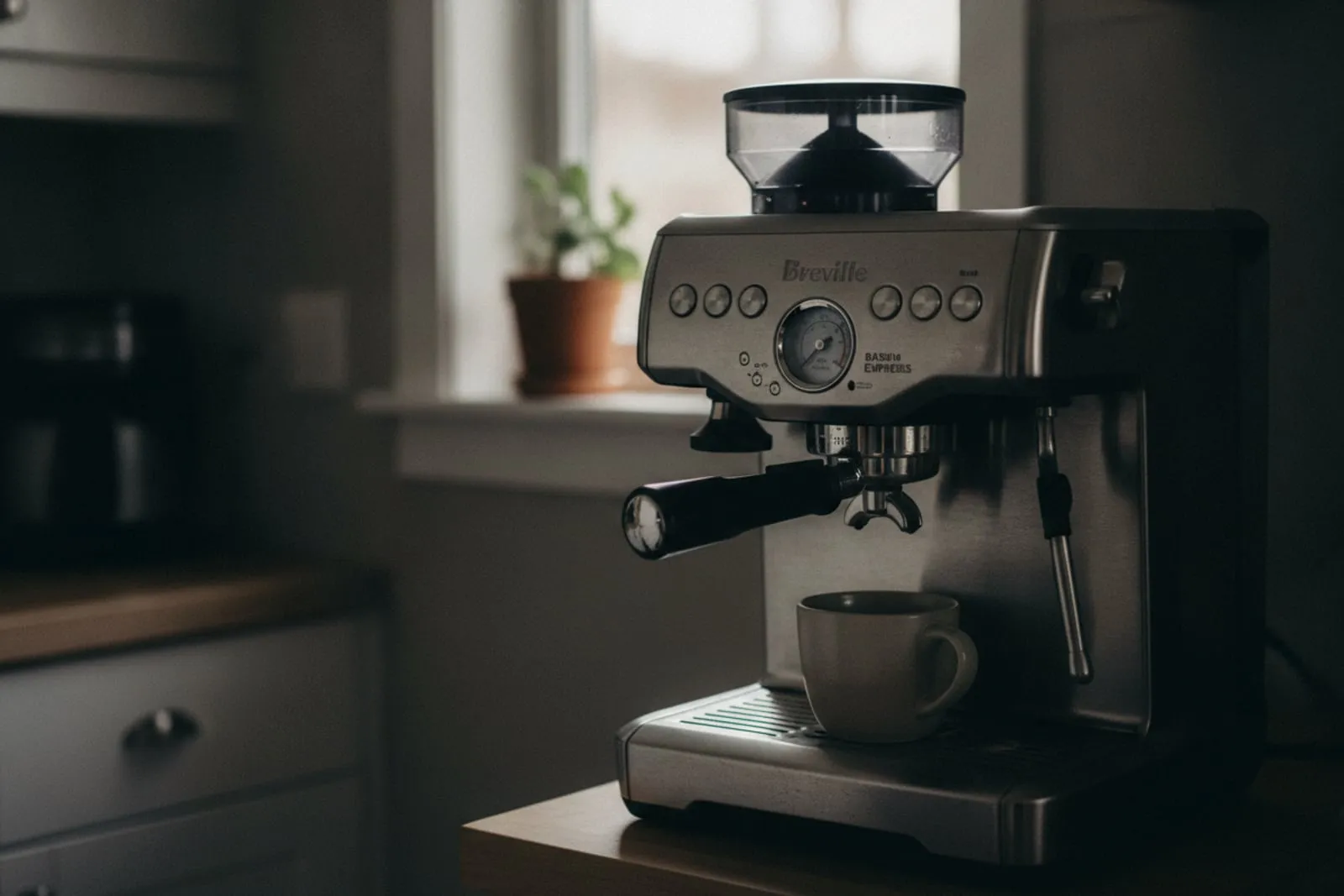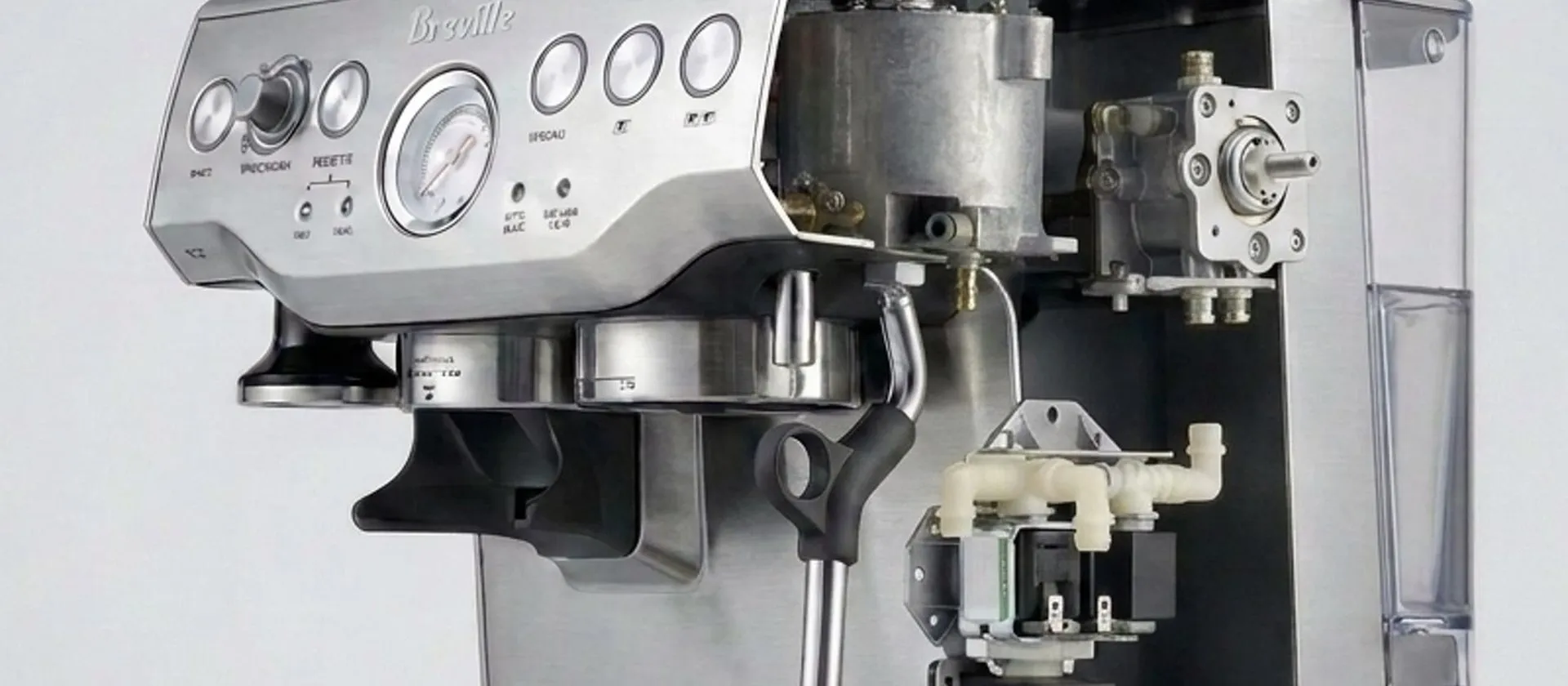
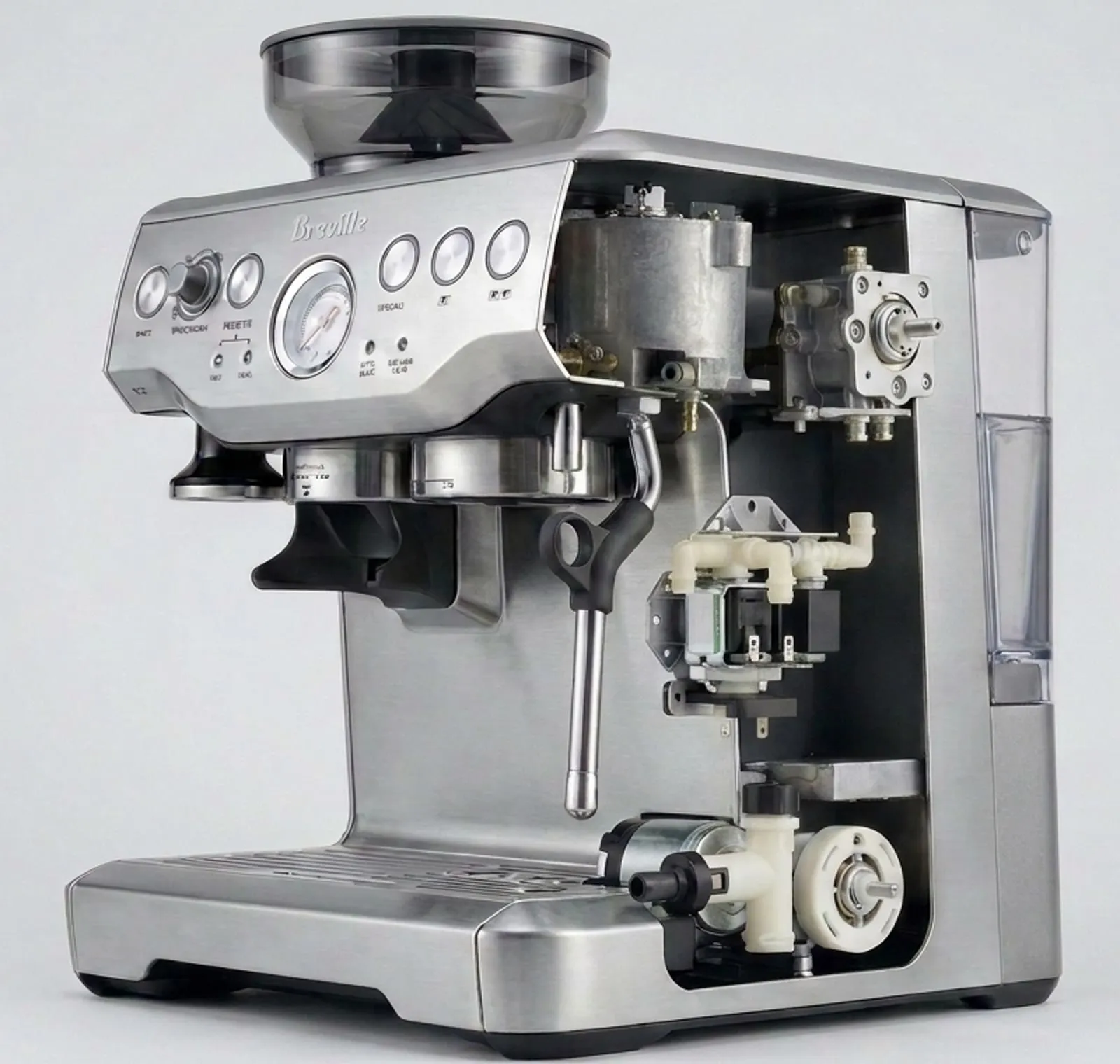
Breville Barista Express parts diagram
Interactive cutaway of the Barista Express BES870XL: tap a part to see what it does, follow the water from tank to cup, then see six months without service.
Most owners of a Barista Express have never seen the right-hand side of the machine with the panel off. That is the side where everything happens: the pump, the heater, the valves and the flow meter all hang on one wall in a space the size of a shoebox. The picture below is that wall. Tap a part and the card on the right tells you what it does and how it fails. Press Start and the water lights up along its real route from the tank to the cup. Press Steam and the same heater runs hotter. The red button shows the same machine after six months on Los Angeles water with no service, with the real photographs next to each part.
How to read the cutaway
The hoses are drawn along the route the water takes in the real machine, fitting to fitting. Tank to flow meter, flow meter to pump, pump up the back wall into the thermocoil, thermocoil down to the valve block, valve block forward to the group. The sections hidden behind the front panel are dotted. The dotted rings on the control panel are the buttons and lights; tap one and you get what the manual says about it, including the combinations Breville never prints on the panel, like the five-second temperature mode behind the PROGRAM button.
Nothing here is a stock illustration. Each component was rendered from photographs of the real part for this model, placed where it sits in the machine, and the outlines you hover over follow the shapes in the photograph. The thermocoil cutaway in the neglect mode is the one schematic image: in the real block the channel is cast into solid aluminum, so a photograph could not show the scale without a saw.
The water path, in order
Water leaves the tank at the back through a small screen and passes the flow meter, a paddle wheel with a magnet that the board counts. That count is the whole volume system of the machine. The 1 CUP and 2 CUP presets are 30 ml and 60 ml of water through the wheel, not seconds, which is why a finer grind makes a double take longer instead of smaller.
The pump is a ULKA EFP5 vibration pump, 120 V and 52 W, rated for 15 bar on the label. At the puck you want about 9, and the small plastic valve on the pump outlet is what keeps the two numbers apart: above its set pressure it bleeds water into the drip tray. Scale on its seat moves that set point, and the symptom is a tray that fills faster than the shots explain.
From the pump the water climbs the back wall into the thermocoil, a cast aluminum block the size of a fist. It has no reservoir. Water heats to 93 °C on the way through and the PID holds the block there between shots. Hot water drops to the solenoid block, where a three-way valve opens the door to the group during the shot and, when you stop, vents the pressure left in the puck down into the tray. That hiss at the end of a shot is the vent working. The second coil on the same manifold serves steam and hot water.
What six months without service looks like
The red button switches every step to the scaled version of the story, and the card for each part shows a clean and a neglected photograph side by side. Most of those photographs came off our own bench. The shower screen with coffee oils in its holes and a split gasket is a BES870XL that arrived with coffee spraying over the top of the basket. The steam wand with milk baked down its whole length is the same machine. The gauge with the needle dead at zero is from a different BES870XL where scale had closed the gauge line, and the owner had been pulling shots by eye for a month.
Here is the honest part. Almost none of these machines arrived with a dead pump. Owners read a loud pump and a weak shot as a pump problem, and on a scaled Barista Express that is nearly always wrong. The pump is working harder against a narrowed thermocoil and a crusted valve seat. Replacing it changes nothing, and $185-$340 is the published range for that fault for a reason: the diagnosis is the expensive part, the pump is a small one. A heating element fault runs $240-$520, and on an Express that is usually the thermocoil itself after years of dry overheats behind the scale.
Steam tells the same story. Weak steam with a clean tip is scale in the thermocoil or the selector valve, not the wand, and that fault sits at $145-$210. A grinder that runs but drops nothing is a packed chute or burrs glazed with oils, about 30 minutes of work at $150-$320. A descaling cycle that will not finish, which owners find when they finally try one, lands at $185-$280.
What it should sound like
Half of the calls we get start with a sound, so the five recordings under the cutaway are there to compare against. Press play and the part that is making the noise lights up on the picture. The shot and the grinder are a Barista Express and its grinderless twin, the Infuser, which carries the same pump, thermocoil and valve block; the purge clip is a cafe machine, and it says so. Two sounds are not in the set, because nobody films their machine failing: a pump with no water, which drops from the steady hum into a hollow, faster buzz, and burrs biting a stone, which is a crack you feel through the counter. Both mean switch off and call.
The two cleanings people confuse
The CLEAN ME light is a shot counter. It asks for a back-flush: the 1 CUP basket, the cleaning disc, one tablet, machine off, then 1 CUP, 2 CUP and POWER held together for ten seconds. Five minutes of pulsing and three beeps later the group and the three-way valve are free of coffee oils. Scale is untouched by all of it.
Descaling is the other job, through the tank, and Breville’s book advises it monthly. On the water in most of Los Angeles County, monthly is about right. The water filter in the tank slows the build-up and is due every two months; it does not stop it. If you have been running CLEAN ME for two years and have never run a descale, the thermocoil cutaway in the diagram is a fair picture of what is inside.
A typical call
Typical call: a BES870XL, four years old, from a kitchen in El Segundo. The complaint was espresso coming out over the top of the portafilter. On the bench the group gasket was hard, cracked and split at one point, the shower screen was half blocked with oils, and the steam wand had a milk crust you could lift with a pick. The fix was a gasket, a screen, a full descale and a grinder clean, which is our flat $249 bench service for the Express family, and the machine went back pulling in the espresso range with the needle where it belongs. Nothing electrical, nothing replaced that was not worn. That is the normal outcome for this machine when it is serviced before the thermocoil goes.
$145 diagnostic — includes pickup from your address and return delivery. It is credited in full toward the repair when you approve the estimate.When the diagram is not enough
If the symptoms line up with the neglected photographs, the machine wants a service, not a part, and the Breville page lists what we do on the Express, the Pro, the Touch and the Oracle. If the machine is past year six and the warranty is gone, read the out-of-warranty guide before you spend anything, because the thermocoil is where that math changes. If you have already descaled and it did not help, that guide covers the next step. Repair and preventive maintenance run on the same courier pickup across the county, with San Jose first on the route, and the current numbers are on the pricing page.